Kmath guide · Updated October 26, 2026
Mathnasium vs Kumon vs Kmath: what each really costs, and what you actually get
Three different ways to get help with math. This page puts them side by side with sources, says who each one fits, and tells you when Kmath is not the right choice.

The short answer
Pick by the problem you are trying to solve
Choose Mathnasium if
your child needs a person beside them, in small groups, and you can drive to a center and budget for it.
Choose Kumon if
your child is steady and does well with a daily routine of self-paced worksheets that build speed.
Choose Kmath if
you do not know why your child is stuck and want the weekly pages built around the skills where their understanding breaks down, in your language, with a full re-check every four weeks.
These are not the only choices, and the best answer can be a mix. If your child just needs to finish tonight's homework, a live lesson or a friendly tutor may be the faster fix. Kmath is built for the case where the same kind of mistake keeps coming back.
Cost
What each one costs, with sources
| Mathnasium | Kumon | Kmath | |
|---|---|---|---|
| Typical price | Not published; each center sets its own. Third-party estimates run from about $200 to $600 or more a month, or $25 to $75 a session. Higher in many areas. | Not published; each center sets its own and charges per subject. Third-party estimates run from about $140 to $400 or more a month for each subject, plus any fees. Some centers charge well above $200 for one subject. | $100 - $260 per student, per month. Your rate follows your household size and income (Kmath Equity). |
| To get started | An initial assessment at the center. Ask what it costs. | A placement test. Ask about any registration fee. | $69 assessment once. No registration fee. |
| Where it happens | At a center, in small groups. | At a center a few times a week, plus daily worksheets at home. | At home on paper, with check-ins on a phone, tablet or computer. No driving. |
| What your child works on | Individual plans taught by center staff. | The next worksheet in a fixed sequence. | A weekly workbook built from your child's diagnosis, following their school class. |
| What you see as a parent | Updates from the center. Ask how often and in what form. | Worksheets and level progress. Ask how reports work. | A report in your language and a full re-check every 4 weeks. |
| More than one child | Per child. | Per child, and per subject. | Per child, each at your household's rate. Each child has their own assessment and plan. |
Mathnasium and Kumon do not publish prices, so the figures above are estimates from the sources below, read in October 2026. Three of those sources are published by companies that sell competing services, so call your local center for a written quote before you compare. Kmath's range is from our pricing page; the rate you pay depends on your household size and income, and you can see yours before you pay anything for the assessment.
Where these numbers come from
We checked each page in October 2026. Three of the four are published by companies that sell competing services; we use them only because they print figures, and they disagree with each other, which is why we show ranges.
- Edubracket: Kumon vs Mathnasium vs Thinkster (prices checked 4 October 2026) (comparison site)
Neither Kumon nor Mathnasium publishes a price; each center sets its own. Kumon tuition is charged per subject. - Brighterly: Best after-school tutoring programs (updated 16 October 2026) (published by a competitor)
Kumon about $140 to $200 a month per subject; Mathnasium about $25 to $35 a lesson (as of August 2026). - Brighterly: Mathnasium vs Brighterly (as of August 2026) (published by a competitor)
Mathnasium about $25 to $75 a session and $200 to $600 or more a month depending on location. The page gives different figures in different places. - Monster Math: Kumon alternatives (published by a competitor)
Kumon about $150 to $200 per subject per month plus fees; Mathnasium about $200 to $500 a month; advises confirming locally.
The whole bill
The real cost to a family is more than the monthly price
Fees and commitments
Ask each center about registration, materials and assessment fees, and whether there is a contract or a notice period. Kmath has a one-time assessment, no registration fee and no contract.
Every child, every subject
Centers charge for each child, and Kumon for each subject. Two children in two subjects can mean four bills. Kmath charges each child at your household's rate.
Your time and travel
Count the drives, the waiting and the evenings. Center programs run on their schedule. Kmath is a paper workbook at your table and short online check-ins, on your schedule.
Kmath Equity: the rate follows your household
Your Kmath rate depends on your household size and yearly income, in a range of $100 - $260 per student, per month. Every child gets the same complete plan at every rate; what changes is the price, which follows what a household can reasonably give. A lower-income household pays toward the lower end. You can see your rate before you pay for anything. How Kmath Equity works
The question most comparisons skip
Why is my child stuck?
Math is built in layers. A child can seem to struggle with equations when the real problem is fractions from two years ago. More practice on the top layer does not reach a step that never became secure. The child gets faster at being stuck.
That is what Kmath is built for. Every child starts with an assessment that looks for the skill where understanding breaks down, and the earlier grade it traces back to, based on how they answer. The workbook then works on that skill first while keeping up with what the class is teaching now.
A wrong answer is a clue. The same kind of mistake often points back to the same earlier skill.
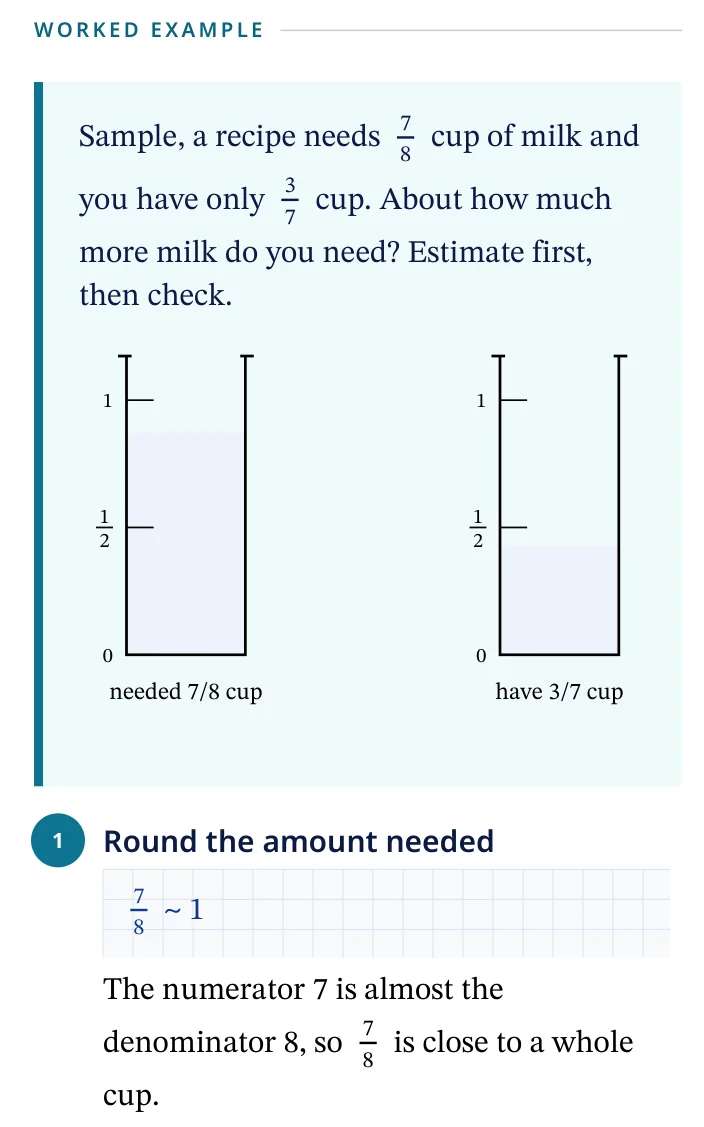
- The problem is set in a real situation, with a picture.
- Each step is named and written in plain words.
- The method is shown: estimate first, then check the exact answer.
Which one fits your child
A quick way to decide
| If this sounds like your child | Look first at |
|---|---|
| Gets homework wrong in different ways each night and needs someone to explain it live | A tutor or a small-group center (Mathnasium or similar) |
| Knows the steps but is slow, and enjoys routine | Kumon or another worksheet program |
| Keeps making the same kind of mistake, or says "I just don't get it" and you cannot tell where it started | Kmath, then add live help only if needed |
| Is ahead and bored | Kmath (the assessment sets harder work and next topics early) or an enrichment program |
| You cannot drive to a center, or your family speaks another language at home | Kmath: at home, with the parent guide and report in English, Spanish, French, Haitian Creole or Portuguese |
Free download
The Kmath Parent Guide
14 pages that show what a week with Kmath looks like: the assessment, a sample workbook, the parent report and how the price works. In English, Spanish, French, Haitian Creole and Portuguese.

Questions parents ask
Is Kmath cheaper than Mathnasium?
Often, but compare the whole cost, not only the monthly number. Kmath is $100 - $260 per student per month, set by household size and income, plus a one-time $69 assessment. Mathnasium does not publish prices; third-party estimates run from about $200 to $600 or more a month depending on the location, and centers may add fees. A lower-income household pays toward the lower end of Kmath's range. The two are different services, so also compare what is included.
Is Kmath tutoring?
No. Kmath is software with a printed workbook. It looks for the skill where your child's understanding breaks down, builds the week's pages around it and re-checks every four weeks. There is no live tutor. If your child also wants live help, you can add it.
Can my child do Kumon and Kmath together?
You can, but we suggest replacing, not stacking. Two sets of worksheets double the load. Kmath keeps the paper-and-pencil habit and builds each page around where your child needs work.
What if my child is ahead?
The assessment looks at how far ahead your child is, so a child who is ahead gets harder problems and next topics early.
What do I get for the assessment?
A report in your language that shows where your child's answers point to gaps and the start of their plan, for a one-time $69. You keep the report whether or not you continue. There is no registration fee and no contract.
How do I know the prices here are current?
Mathnasium and Kumon set prices center by center and do not publish them, so the figures above are third-party estimates read in October 2026. Always ask your local center for a written quote.
See your rate, then decide
Answer three short questions to see your family's rate before you pay for anything. Then take the assessment when you are ready.
$69 assessment once, then $100 - $260 per student, per month. Billed monthly. Cancel any time.