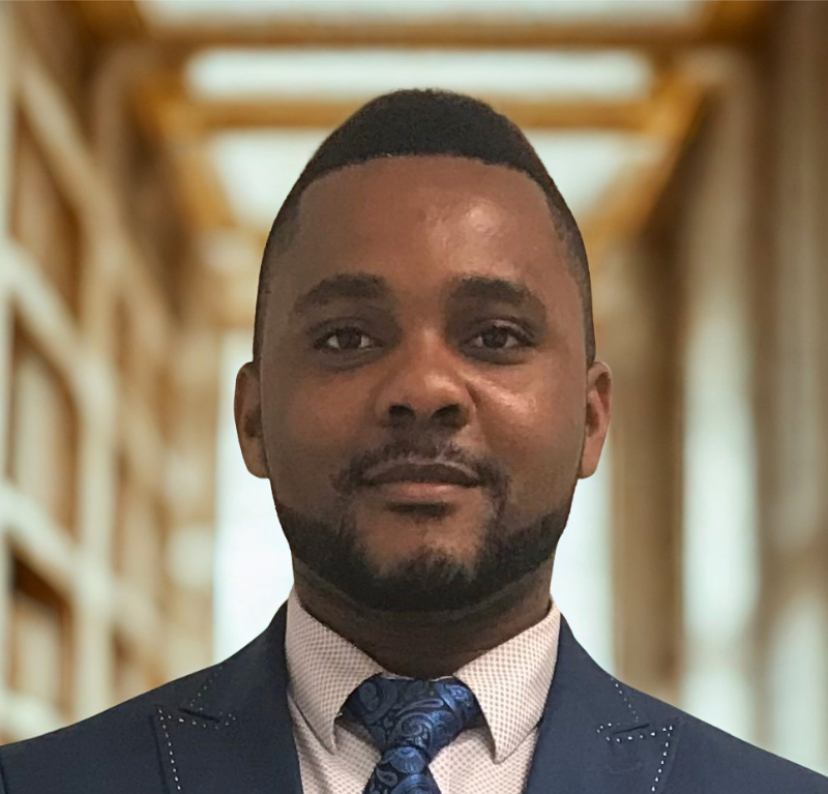
The Founder
Kelly O. Jakpa
Educator. Diagnostic specialist. Founder of Kmath.
20
years with students
9
years running a center
5
launch languages
Educator. Diagnostic specialist. Founder of Kmath.
Intelligence was always there.
The layer covering it just needed time to become visible.
He saw through it.
Kelly O. Jakpa grew up in Nigeria where his relationship with mathematics was different from the start. While other students memorized steps, Kelly instinctively broke problems down into their smallest pieces and rebuilt them in ways that made sense. Not just to himself. To everyone around him. By elementary school he was already tutoring classmates.
The moment that changed everything came in middle school, when Kelly was introduced to a private tutor who did something unusual. He taught Kelly ahead of his grade level. While still in middle school, Kelly was learning high school mathematics, including calculus.
Math is not hard. It is simply layered. And anything layered can be broken down.
Once Kelly understood that complex mathematics is just a combination of smaller, simpler skills built in a specific order, everything clicked. More importantly, he realized he could make it click for others. He began tutoring high school students while still in middle school himself. That gift followed him.
he became the one who could explain it.
In boarding school, Kelly became the person students came to when they could not understand. Not because he was the smartest person in the building. Because he could explain mathematics in ways that others could not. He combined unconventional explanations, pattern recognition, and techniques that made concepts stick.
Students did not just learn. They understood. There is a difference, and Kelly knew it. A student who learned a rule could apply it once. A student who understood the rule could apply it anywhere, and could explain it to someone else.
Understanding over memorization. That distinction became the philosophical core of everything Kmath would eventually be built around.
Then came a new country, a new language, and the same problem seen from a completely different angle.
from the other side.
When Kelly arrived in the United States in 2016, he brought his ability to teach and found an entirely new dimension of the same problem. Families navigating school systems that were not built for them. Children falling further behind while parents received no real explanation.
Parents who could not help their children with homework. Not because they were unintelligent. Because the system was in English. The report was in English. The meetings were in English. They were not uninvolved. They were excluded.
He began working with students in schools and communities across every background. Haitian families. Spanish-speaking households. Portuguese communities. Asian families. Black American households. And across every single one of them, the same truth appeared.
Students were not failing because they were incapable. They were failing because no one had broken it down for them. And no one had explained it to their parents in a language they could act on.
Kelly's approach worked. Students improved. Confidence grew. Families trusted him. But the better he got at the work, the more clearly he could see the ceiling above it.
in one room at a time.
No matter how effective Kelly was, his reach had a ceiling. One student at a time. One session at a time. One location. His way of thinking, the diagnostic instinct that found the exact broken step, the teaching approach that explained it until it connected, could not travel beyond the room he was in.
When he left, he took everything he knew about that child with him. The next week, school had moved forward. The gap was still there. He was always one step behind the classroom.
The question he kept returning to was not how to reach more students. It was more fundamental than that.
How do you multiply a way of thinking? How do you turn a diagnostic instinct into a system that runs without you in the room?
The answer took years to find. When it came, it was not about hiring more people. It was about a completely different kind of decision.
He decided to systematize himself.
Kmath was born from a single decision. Instead of hiring more people, Kelly would encode his method. The diagnostic logic. The layered breakdown. The way of finding where understanding broke. The way of communicating with parents in their own language. All of it built into a system that could run for any student, in any language, without him needing to be present.
Kmath is not a tutoring company. It is a deterministic learning system that does what Kelly always did: finds exactly where understanding broke down, rebuilds it from that point, and keeps the parent informed every step of the way in the language they think in.
The scale Kelly could not achieve in a room, Kmath can achieve everywhere. But to understand why it matters so much, you have to see what he kept watching happen to family after family.
Every approach treated the symptom. The failing grade. The subject struggle. Nobody traced backwards to find the specific skill that had collapsed years earlier. Kelly's diagnostic instinct was the only thing doing that work, and it was locked in his head.
In family after family, capable and caring parents could not participate in their child's education because everything was in English. The reports. The meetings. The homework. The tutoring. They were not uninvolved. They were excluded.
Children labeled bad at math did not struggle with ability. They struggled with confidence. Years of repeated failure at the symptom level, without anyone finding the cause, had turned curiosity into fear. Kelly had seen that fear dissolve the moment the right explanation arrived.
Pencil on paper builds understanding and retention that screens cannot replicate. Your child gets a workbook every week. The portal handles the short check-ins. The kitchen table handles the learning.
Kmath has streaks, certificates, and badges built to celebrate real academic milestones. Not login frequency. A certificate means your child completed a gap-closing arc. Every reward marks a real academic event.
Frequent, correctly guided practice is the primary driver of math mastery. Not longer sessions. Not harder problems. Five to six days per week of short correct practice builds the understanding that one weekly session cannot create.
When a student can explain a concept to someone younger, they have genuinely mastered it. Explaining to a sibling, a cousin, a younger friend is not a bonus activity. It is the mastery check.
When will I use this? is the question every student asks and every textbook ignores. Kmath connects every concept to a real context where this math matters. A child who understands why will always outperform one who only knows how.
The DCAR updates every four weeks. As your child progresses, the gap changes, the sequence changes, the pacing changes. Kmath does not have a syllabus. It has a diagnostic system that generates the right next lesson for this child, at this moment.
I built Kmath because I am an educator who knows the limits of education. I am someone who worked one-on-one with students for twenty years and knows the limits of that work. I am an immigrant who knows the limits of a system that was never built for the people it claims to serve.
Kmath is not perfect. No product is. But the intention is real. The work is real. And the people it was built for, the grandmother raising her grandchildren while their parents work two jobs, the parent who speaks three languages but not the one the school communicates in, the child who is brilliant and has never once been told so by a system that only measured what it knew how to measure, those people were not an afterthought. They were the reason.